.png)
_svg.png)
%20PTFE%20Bellows%20%5BALT%5D.jpg)
PTFE Bellows
PTFE bellows are ideal for chemical processing, pharmaceutical and food industries due to their non-reactive, corrosion-resistant properties. Made from polytetrafluoroethylene (PTFE), they handle aggressive chemicals and high-purity media with ease. These flexible expansion joints absorb vibration and compensate for movement in systems where metallic or rubber bellows would fail due to the high corrosion or high purity environments..

What Are PTFE Bellows?
A PTFE bellows is a flexible bellows element made from PTFE, a fluoropolymer valued for excellent chemical compatibility and low contamination risk. PTFE bellows are typically used to:
-
Absorb axial, lateral and angular movement in pipework;
-
Reduce stress at equipment connections and flanged joints;
-
Provide flexibility in systems handling corrosive or high purity media;
-
Protect fragile process systems in chemically harsh environments;
-
Help manage vibration where a chemically resistant flexible connection is needed.
You will often see these terms used together in specifications:
-
PTFE bellows;
-
PTFE expansion joints;
-
PTFE expansion bellows;
-
Chemical-resistant bellows.
When PTFE Bellows Are The Right Choice
PTFE bellows are commonly selected when chemical compatibility and cleanliness are the dominant requirements, for example:
-
Media that can attack elastomers or corrode metallic materials;
-
High purity duties where contamination must be minimised;
-
Systems with regular cleaning, aggressive washdown, or chemical exposure;
-
Pipework that experiences thermal movement but needs a chemically resistant flexible joint.
For improved pressure containment, PTFE bellows can be strengthened with reinforcing rings or an outer metal layer, but if the duty is primarily high temperature, high fatigue cycling, or high integrity pressure duty, a metallic approach may be more appropriate (see Metal Expansion Joints). In many plants, PTFE bellows and metal bellows both have a place, depending on the line and the duty profile.
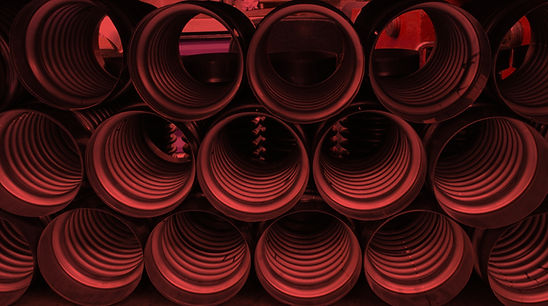
Typical Applications & Sectors Of PTFE Bellows
PTFE bellows and PTFE expansion joints are commonly used in:
-
Chemical processing and industrial chemistry;
-
Pharmaceutical and high purity systems;
-
Water treatment where chemical dosing and aggressive cleaning regimes apply;
-
Industrial utilities handling corrosive or difficult media;
-
Skids and modular systems needing tolerance for movement and installation variability.
They are often used at equipment connections, pump and filter interfaces, subject to harsh media or high vibration.
Configurations & Options For PTFE Bellows
PTFE bellows can be supplied in different configurations depending on duty and installation constraints. Common variables include:
-
Connection interfaces - flanged interfaces are common, with drilling and standards matched to your system;
-
Installation length and envelope - engineered to suit space constraints and required movement;
-
Movement profile - axial, lateral and angular movement, including combined movement cases;
-
Vacuum support features - where vacuum conditions are present, additional design provisions may be required to maintain stability;
-
Hardware and restraint - in some systems, control hardware may be required to manage travel and loads, depending on how the line is restrained.
The correct configuration is driven by the system, not just the component. A PTFE expansion joint should be selected as part of an overall pipework movement and restraint strategy.

Key Design Consideration For PTFE Bellows
PTFE bellows performance is highly dependent on matching the bellows to the duty profile. We focus on:
Chemical Compatibility and Concentration:
-
Media identity, concentration, and contaminants;
-
Any cleaning or flushing chemicals used during operation or maintenance;
-
External chemical exposure in the plant environment.
Pressure, Vacuum and Stability:
-
Operating and design pressure;
-
Surge conditions and pressure cycling;
-
Any vacuum conditions that could affect stability.
Temperature Profile and Thermal Cycling:
-
PTFE bellows can go up to 200°C, but this can be increased with extra hardware;
-
Start up and shutdown cycles and temperature transients;
-
Local hot spots that can drive accelerated ageing or deformation.
Movement, Misalignment and Cycle Expectations:
-
Required movement in each direction;
-
Installation tolerance and misalignment allowances;
-
Expected movement frequency and required service life.
Long-Term Behaviour and Maintainability:
-
PTFE can behave differently from metal under sustained loads, so correct selection and installation are important;
-
Accessibility for inspection and replacement, especially in aggressive environments.
These factors are also why a strong specification and good installation practice are essential for long service life.
Inspection, Testing & Documentation Support
Depending on your project requirements, PTFE bellows supply can be supported with appropriate verification scope, such as:
-
Dimensional verification and interface checks;
-
Pressure testing where specified;
-
Documentation packs aligned to traceability and project expectations.
The exact scope depends on the application, sector requirements and your project specification.
How To Request A Quote (What We Need)
To quote accurately for PTFE bellows or PTFE expansion joints, please provide:
-
Pipe size and connection details, including flange drilling standard;
-
Process media, including concentration and contaminants;
-
Operating and design temperature, including transients;
-
Operating and design pressure, including surge and cycling;
-
Any vacuum conditions, if applicable;
-
Required movement: axial, lateral and angular, plus expected frequency or cycle expectations;
-
Available envelope (overall length) and installation constraints;
-
Any required standards, documentation, inspection or testing expectations.
If you are unsure about movement values, a simple sketch, piping layout, or photos of the installation can help us guide the specification.
FAQs About 'PTFE Bellows'
Are PTFE bellows the same as PTFE expansion joints? In many specifications the terms are used interchangeably. In practice, an expansion joint may refer to the assembled unit including interfaces and any hardware, while bellows describes the flexible PTFE element.
When should I choose PTFE bellows instead of rubber bellows? PTFE bellows are typically chosen when chemical resistance or purity requirements are high. Rubber bellows are commonly used for HVAC, water and general services where vibration isolation is the priority and media compatibility is suitable.
Can PTFE bellows handle vacuum conditions? Yes, but vacuum requirements must be specified so the joint can be engineered appropriately as this will not be assumed as a default.
What is the fastest way to get a quotation? Send drawings or flange details plus media, temperature, pressure and movement requirements.
Read more FAQs here


