.png)
_svg.png)
%20Squirm%20Testing.jpg)
Destructive Testing
In addition to Non-Destructive and Fatigue Testing, we conduct Squirm and Burst Testing under pressure and temperature-controlled conditions. Squirm Testing is a destructive test which identifies the pressure point at which bellows lose structure due to instability by simulating internal pressure conditions. Burst Testing determines the maximum pressure capacity of expansion joints by applying internal pressure until failure, confirming whether it conforms to the relevant safety margins and industry standards.
Call us • Contact sales • Consult an engineer • Choose FastTrack for urgent orders

What Destructive Testing Is Used For
Destructive testing helps answer:
-
At what pressure does a bellows lose structural stability (instability threshold)?
-
What is the maximum pressure capacity before failure (burst limit)?
-
Do the results align with required safety margins and acceptance criteria?
-
How do pressure and temperature conditions influence stability and ultimate strength?
This is especially valuable for the most severe duty systems requiring hard proof of durability rather than calculation alone.
Squirm Testing (Bellows Instability Testing)
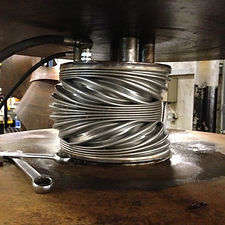
Squirm testing is a destructive test that identifies the pressure at which a bellows loses structural integrity due to instability under internal pressure.
In practical terms, squirm testing:
-
simulates internal pressure conditions that can trigger bellows instability;
-
identifies the pressure point at which the bellows loses structure;
-
supports confirmation of stability margins for designs where buckling or instability is a known risk driver.
Squirm behaviour is often influenced by bellows geometry, construction approach and boundary conditions, which is why a controlled test programme can be valuable for validation.

Burst Testing (Maximum Pressure Capacity Testing)
Burst testing determines the maximum pressure capacity of an expansion joint or pressure-containing assembly by applying internal pressure until failure.
Burst testing is used to:
-
confirm the ultimate pressure limit of the component;
-
verify whether the design conforms to required safety margins;
-
support acceptance against relevant industry standards and project requirements.
The purpose is not only to observe failure, but to quantify the margin between operating and failure thresholds in a way that is defensible for safety and compliance discussions.

Pressure & Temperature-Controlled Conditions
Where required, destructive tests can be planned under controlled conditions to better reflect real duty:
-
internal pressure profiles aligned to the test intent;
-
temperature control where temperature affects material behaviour and stability;
-
documentation of conditions so results are interpretable and usable for design decisions.
Your exact test conditions should be defined by the duty profile, component type, and what you need the test to prove.
When Destructive Testing Is Most Valuable
Destructive testing is typically recommended when you have one or more of the following:
-
stability risk is a design driver (buckling, instability, squirm risk);
-
high pressure duty or severe pressure cycling where margins must be validated;
-
a new design, geometry or construction approach requiring validation;
-
safety-critical applications where documented failure thresholds are required;
-
programmes where compliance discussions require objective test evidence;
-
a failure history where instability or ultimate strength is in question.
Destructive testing is often paired with fatigue testing, where fatigue establishes life and destructive tests establish limits.
What You Receive
Deliverables depend on your programme scope, but typically include:
-
confirmation of test method and conditions;
-
recorded squirm threshold or burst pressure results (as applicable);
-
interpretation against agreed acceptance criteria or safety margin expectations;
-
test records and documentation aligned to your project requirements;
-
practical recommendations where results indicate design changes or verification needs.

How To Request Squirm Or Burst Testing
To define the right test scope and quote accurately, please provide:
-
component drawings and identification details;
-
material specification and construction details where available;
-
operating and design pressure, plus any pressure cycling profile;
-
temperature profile and whether temperature-controlled testing is required;
-
the purpose of the test: validation, compliance evidence, failure investigation, margin confirmation;
-
acceptance criteria or standard requirements and documentation expectations;
-
programme constraints and required dates.
If you are investigating a failure, include photos, service history and the conditions at the time the issue occurred.
FAQs About Destructive Squirm Or Burst Testing
What is squirm testing for bellows? Squirm testing identifies the pressure point at which a bellows loses structure due to instability under internal pressure, helping confirm stability margins.
What is burst testing for expansion joints? Burst testing applies internal pressure until failure to determine maximum pressure capacity and verify safety margins against the relevant requirements.
Can squirm and burst testing be performed under temperature-controlled conditions? Yes. Where temperature influences material behaviour or stability, tests can be planned under pressure and temperature-controlled conditions to reflect duty requirements.
How do destructive tests relate to fatigue testing? Fatigue testing verifies life under cyclic duty, while destructive tests establish instability and ultimate strength limits. Together they provide a more complete validation picture.
What information do you need to quote destructive testing quickly? Drawings, material and construction details, target pressure and temperature conditions, purpose of testing, acceptance criteria and documentation requirements are typically sufficient.
Read more FAQs here


